Nuclear Energy is Central to Rwanda’s Development Strategy –President Paul Kagame
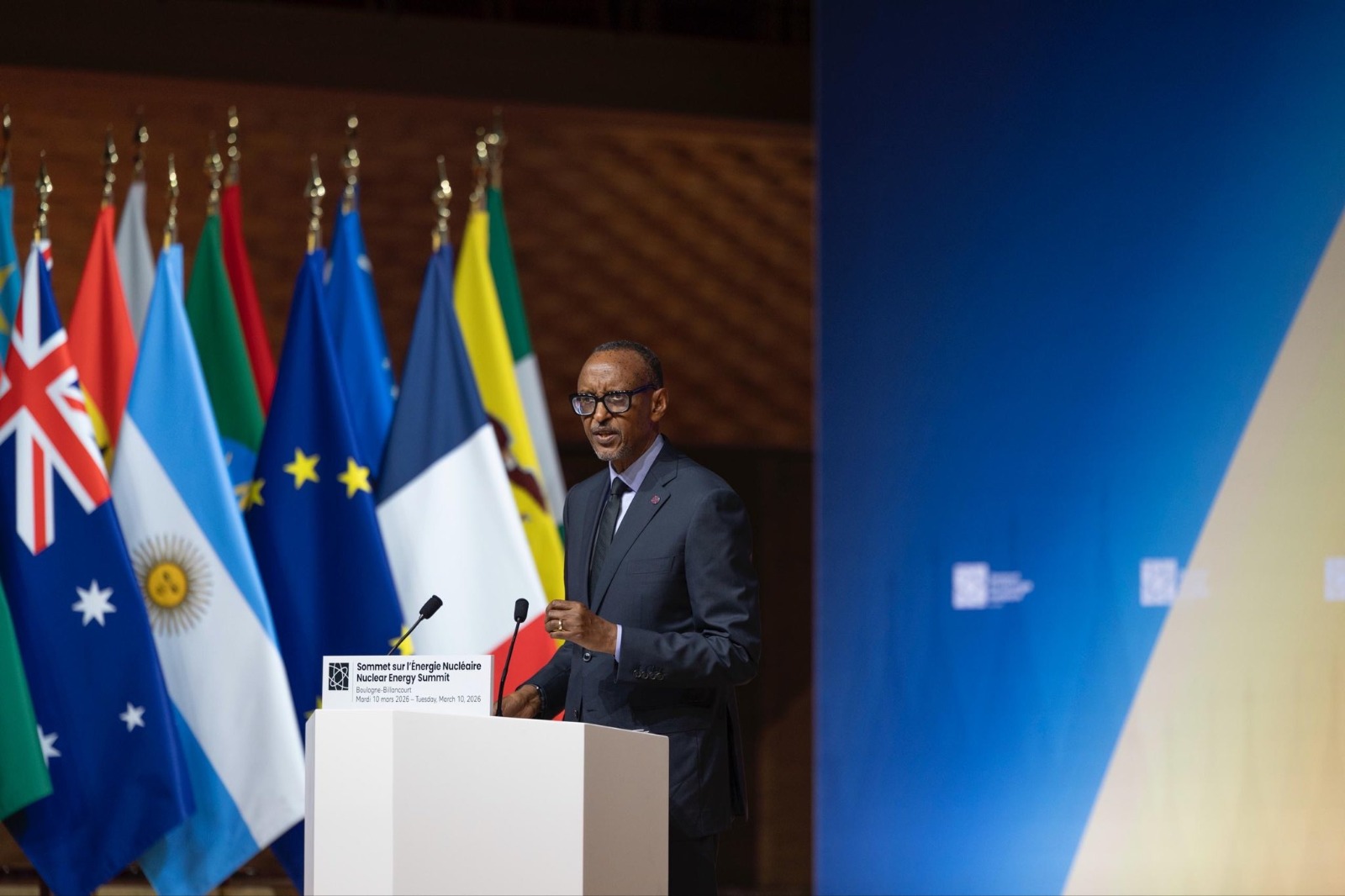
Kigali –March 10, Rwanda aims to be a high-income country by 2050 and this requires abundant electricity, said President Paul Kagame during Nuclear Energy Summit 2026, adding that this is why the country has decided to make nuclear energy central to its development strategy.
Nuclear Energy Summit, held in Paris, France, brought together heads of state and government, representatives of international organisations, financial institutions, industry leaders and experts in discussions aimed at promoting a safe, secure and peaceful civilian nuclear industry.
President Kagame emphasized that Rwanda is determined to do what it takes to power its development with nuclear energy, noting that achieving this requires strong institutions, sound regulation, and an educated workforce, which is the foundation Rwanda is building.
“It will diversify our energy mix while providing the stability required for industrial growth and long-term transformation,” he said, adding that achieving such targets requires strong institutions, sound regulation and an educated workforce.
“That is the foundation Rwanda is building. Today, we are grateful to the International Atomic Energy Agency for supporting the Rwanda Atomic Energy Board as well as our national regulator in this endeavour,” he said.
The summit comes at a time when the IAEA conducted an Integrated Nuclear Infrastructure Review in Rwanda and confirmed progress across the key pillars of building a strong and secure nuclear energy programme
“Our country is prepared to proceed through the agency's milestone approach to the next stage. Nuclear technology is evolving in ways that benefit countries with small grids, allowing Africa to be among the early adopters. Small modular reactors (SMRs) in particular are especially suited to Africa's requirements,” the Head of State said.
He expressed confidence that Africa will emerge as one of the most important global markets for SMRs in the years ahead and called for stronger international cooperation to support the continent.
“Nuclear energy projects require tailored financing packages, which are still unfamiliar to development banks. Last year, the World Bank decided to end the ban on financing nuclear power projects. At COP28, governments called on international financing institutions to include nuclear energy in their portfolios. Now is the time to work together to make this shift a reality in Africa.”
“Nuclear energy is not too complex or risky for developing countries. The standards developed by the IAEA provide a universal framework that can be applied by countries at every income level,” he said.
The President also told global leaders that Rwanda will host the 2026 Nuclear Energy Innovation Summit for Africa (NEISA) noting that it will be a continuation of conversation on making financing nuclear energy a reality in Africa.
Themed “Powering Africa’s Future, turning Nuclear Energy Ambition into Investable Reality”, NEISA 2026 will convene Heads of States and Governments, policy Makers, financiers, regulators and Nuclear Energy technology and service providers to focus on shared direction, fit-for-purpose financing approaches, and structured deployment pathways, particularly for small modular reactors and micro modular reactors.